Tile match and mahjong solitaire look alike: a pile of picture tiles in layers, and a goal of clearing them all. They play quite differently, though. Here's how.
Mahjong solitaire: free pairs
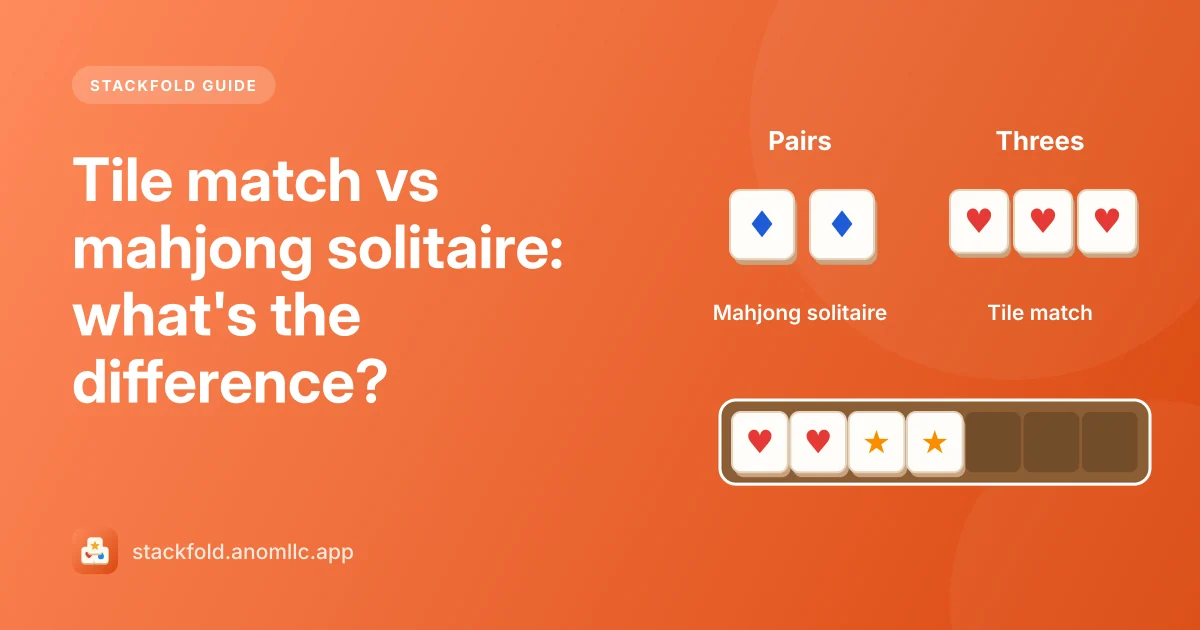
In mahjong solitaire, you remove pairs. A tile is free when nothing is on top of it and its left or right side is open. Tap two free tiles with the same picture and both disappear. There's no tray: the only limit is whether you can still find a free pair.
The classic tiles come from the Chinese game of mahjong (bamboos, circles, characters, winds, dragons, flowers and seasons). If you'd like to try it, Anom's Tilefold is a calm mahjong solitaire.
Tile match: threes in a tray
In tile match (triple tile), you collect sets of three. A tile is free when nothing is on top of it; the sides don't matter. Tapping a free tile moves it into a tray of seven slots, and three of a kind in the tray clear away. If the tray fills with seven tiles and no set, the level is lost.
The differences that matter
| Mahjong solitaire | Tile match | |
|---|---|---|
| You remove | Pairs | Sets of three |
| A tile is free when | Nothing on top and a side open | Nothing on top |
| Where tiles go | Straight off the board | Into a 7-slot tray |
| How you lose | No free pair left | Tray full |
| Main skill | Spotting pairs, unblocking long rows | Managing the tray, finishing sets |
In practice, mahjong solitaire is about seeing: scanning a big board for matching free tiles. Tile match is about planning: every tile you take sits in the tray until two more join it, so each tap has a cost.
Which should you play?
- If you like a slow, observant game where any free pair is fine, mahjong solitaire suits you.
- If you like a little tension, and thinking two or three taps ahead, tile match is more fun.
Both are calm, offline puzzles with no timer. In Stackfold, every level is dealt so it can be cleared, and three helpers (Undo, Magic and Shuffle) are there when you need them. New to it? Start with how to play tile match.